Architecture, operations & growth

Continuous Integration & Delivery (CI/CD)
Every change is built and tested automatically, and good changes move towards production with as few manual steps as possible.

Our DevOps services help your team ship more often with fewer surprises. We automate builds, tests and deployments, put your infrastructure into code and set up the monitoring that tells you about problems before your users do.
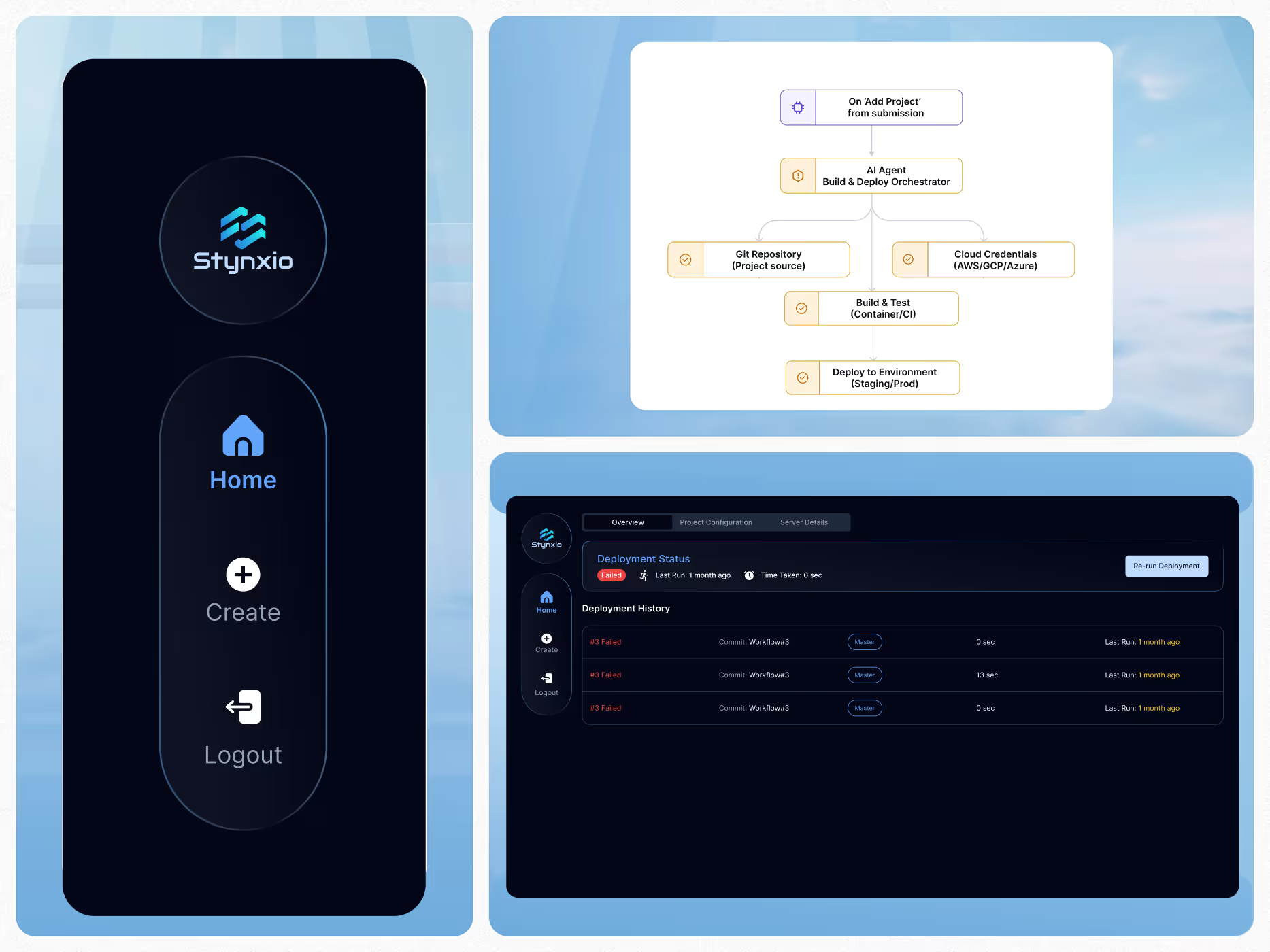
Deployment is a subject we know well: Stynxio, one of our products, is a DevOps platform for project setup, credential management and deployment, with automated pipelines and rollback. We bring the same thinking to your projects.
Slow, manual releases cost more than time. They make teams nervous about shipping, hide problems until users report them and turn every deployment into an event. Good DevOps practice turns releases into a routine. We look at how your code moves from a developer’s laptop to production today, find the steps that are slow, risky or dependent on one person, and automate them. We right-size the tooling to your team and budget, from a simple pipeline for a single application to containerised, multi-environment setups, and we document everything so your team stays in control. The result is faster feedback, fewer failed releases and infrastructure you can rebuild with confidence. We also make sure someone is told when things go wrong: alerts reach the right people, logs are easy to search, and common problems have a written runbook so anyone on the team can respond.
Every change is built and tested automatically, and good changes move towards production with as few manual steps as possible.
Repeatable, one-step deployments with a quick rollback path take the risk and late nights out of releases.
Servers, networks and services are defined in version-controlled code, so environments can be recreated, reviewed and audited.
We containerise applications with Docker and run them on Kubernetes or simpler hosting, depending on what your scale really needs.
Logs, metrics and alerts show how your system is behaving, and we use them to find and fix bottlenecks.
Secrets management, access control, dependency checks and audit logs are built into the pipeline rather than checked at the end.
We review how you build, test, deploy and monitor today, and where time is lost.
We agree a roadmap that delivers the biggest improvements first.
We build the pipelines, infrastructure code and deployment process.
We add monitoring, logging and alerting, with runbooks for common issues.
We document everything, train your team and keep improving.
We run workloads on the cloud provider of your choice, for example AWS, Azure or Google Cloud, or on your own servers. If you already have pipelines in place, we start by improving them rather than replacing them.
Stynxio integrates with GitHub, GitLab, Bitbucket, Docker and Kubernetes, so these tools are part of our daily work.
Our engineers write the applications and the pipelines that deploy them, which avoids hand-off friction.
We do not add Kubernetes when a simpler setup will do. You get the tooling your scale needs.
Pipelines and infrastructure are documented so your own team can run them.
CI/CD pipelines, automated deployments, infrastructure as code, containerisation, cloud setup, monitoring and security integration. We start with the areas that slow your team down most.
Yes, in a lightweight form. Automated tests and one-step deployments save small teams the most time. We keep the setup simple and affordable.
Not always. Kubernetes is powerful but adds complexity. For many products, containers on simpler managed hosting are enough. We recommend what fits.
Yes. We work with your current repository host, cloud provider and tools, and improve them rather than replacing everything.
Secrets are kept out of code in a secrets manager, access is role-based and pipelines include dependency and configuration checks.
Yes. We document pipelines and infrastructure and walk your team through them, so your own team can run them.
Robust, scalable software architectures that align technology with your business goals and grow with your product.
Learn moreCustom and user-centric web applications that drive growth through innovation, functionality, and seamless digital experiences.
Learn moreScalable and efficient database solutions that ensure performance, reliability, and a strong foundation for your business.
Learn moreTell us what you are building. We will reply with questions, ideas and a clear next step.